A Humble Hero
By Ayshah
Article copywritten and used with permission.
All rights reserved.
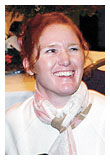 Retired Army
Captain Dawn F Halfaker of Ramona, CA never expected to be called a
hero. In fact, she used to be uncomfortable with the title. Still, it's
something that she's had to get used to because - regardless of how she
sees herself - this is the way many others see her.
Retired Army
Captain Dawn F Halfaker of Ramona, CA never expected to be called a
hero. In fact, she used to be uncomfortable with the title. Still, it's
something that she's had to get used to because - regardless of how she
sees herself - this is the way many others see her.
Halfaker graduated from the United
States Military Academy at West Point, NY in 2001. Then she went on to
join the Army's Military Police Corps where she served a year in Korea
and then in the 293D Military Police company at Fort Stewart, GA. She
was later deployed with her company, where she was assigned to train
the Iraqi police in Ini Baqubah during the transition period after the
fall of Saddam Hussein's regime.
In June of 2004, a rocket-propelled
grenade (RPG) was shot into Halfaker's armored Humvee, piercing through
her right side.
"After I was hit I felt like my mind
and senses were thrown into a state of chaos and confusion. Then the
pain hit and took over my mind and body. I also became very anxious
because I felt like I could never catch my breath. It was like I was
drowning or something," Halfaker said. Before she initially lost
consciousness, she recalls yelling the order to her uninjured driver
"get out of the kill zone!"
Although it is expected of every
military officer to maintain their leadership skills through stressful
circumstances, many people consider her heroic in her ability to give
orders while her arm was severely mangled.
Halfaker sustained serious injuries to
her right arm and lungs. Military doctors amputated her arm after
infection set in. She was then sent to Walter Reed Army Medical Center
in Washington, D.C., where doctors were forced to put her in a
drug-induced coma to fight off the swelling in her lungs and infection
from her wounds.
After her injury Halfaker lived at the
Fisher House, which is near the respected Army hospital Walter Reed in
Washington DC. It is where soldiers who are recovering from their
wounds get physical therapy on a regular basis. Although her dreams of
playing basketball again were crushed, she remained hopeful about her
future.
Captain Halfaker had a rewarding
experience working with her Physical Therapists. In fact, she describes
the physical therapists she worked with at Walter Reed as "extremely
organized and dedicated." She also added, "They do not just treat the
injury, they treat the person. They succeed at raising the morale of
their patients by making the weekly schedule creative, fun, and filled
with as much laughter as possible." Though Halfaker's physical
therapists helped her learn to cope with the loss of her arm, choosing
to use a prosthetic -and finding one that was comfortable, effective,
and that looked appropriate- was a challenge for her, just as it is for
many other amputees.
"Many people want to see me wearing a
prosthetic arm because it makes me look like my wound is healed to a
certain point, and it hides my injury," she says. "A prosthetic arm
puts others at ease because they think of the patient as being
complete, recovered, and functional." Halfaker ultimately chose a
passive prosthetic arm that has no function, but it is the most
comfortable to wear, and looks like a real hand; in fact, it looks like
her real hand, down to the skin tone and the painted-on freckles. "It
is the most comfortable and looks the nicest," she says. On how
Halfaker actually feels about her body after the injury she said: "I
find that I am more focused on what I do have left, and that I am lucky
to be alive rather than what I have lost - so I stay upbeat. However, I
do get frustrated at times when I come across a physical task I cannot
do and sometimes when I look in the mirror and see what I have lost."
During her stay at Fisher House,
Halfaker's life was filled with activity. Besides meeting President
George W. Bush, Hillary Clinton, Lieutenant General William J. Lennox,
Jr. (the superintendent of West Point), Adam Sandler, and rock star
Ozzy Osborne, she was up early three days a week for her 2 to 3 mile
run each morning, physical therapy, orthopedic consultations, amputee
clinics, career counsel meetings, and various other events which
changed week to week. In addition to all of this, Halfaker worked two
days a week for Congressman Duncan Hunter in Washington D.C., the Armed
Forces Services Comity chairman. In her work for Congressman Hunter,
she had a variety of responsibilities from sitting in on meetings with
key military personnel to talking with the general public about
legislative issues. Halfaker has also appeared on numerous television
shows, such as: Hardball, CBS and MSNBC evening news, and the Montel
Williams show. She even graced the cover of the USA TODAY newspaper.
Halfaker has sacrificed a great deal
for her country including her ability to play basketball, a sport which
she excelled in and enjoyed. Although she has discovered new sports and
activities, nothing will ever fully replace basketball in her life.
Halfaker is currently attending
Georgetown University, and she is working for the Defense Advance
Research Projects Agency (DARPA). Her main career goal is to be able to
impact people's lives in a positive way.
When Halfaker took a moment to reflect
on how far she has come since the day of her injury she said, "I loved
the life I had before, but it's just different now - not better or
worse."
The term "hero" often
used by others to describe Halfaker since her return from Iraq is
flattering to her even though she does not think of herself as a hero.
"I am flattered and honored when people take the time to recognize my
service and sacrifice, but I would never call myself a hero, as
everyone serving in the military is a hero whether injured or not. I
was just doing my job."
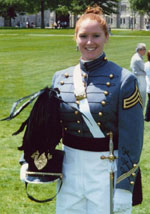
Dawn as a cadet.
|
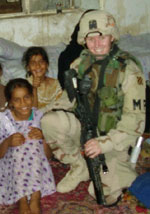
Dawn in Iraq.
|
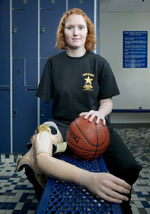
Dawn after the attack.
|
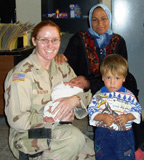
Dawn in Iraq.
|